
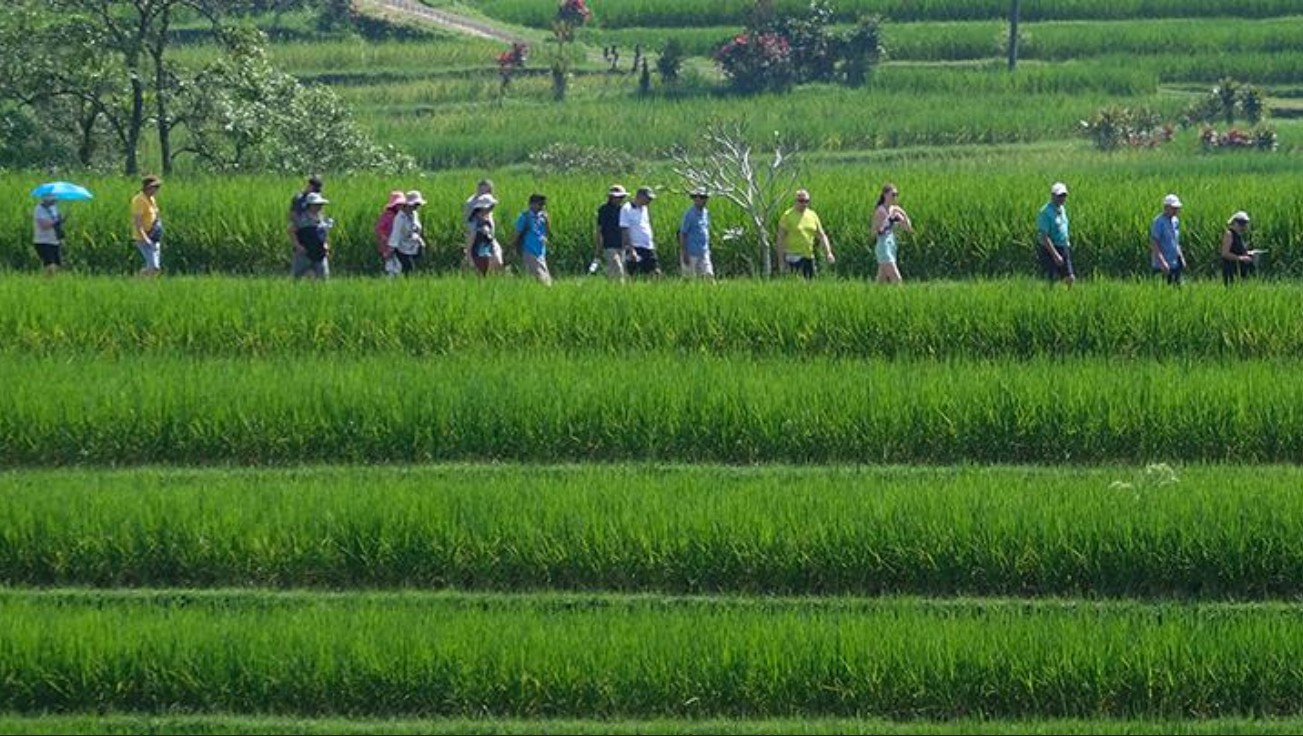
Minister of Agriculture and Head of the National Food Agency, Amran Sulaiman, confirmed that he has established communication with the Minister of Agrarian Affairs and Spatial Planning/Head of the National Land Agency, Nusron Wahid, regarding the ongoing issue of the conversion of productive rice fields in Bali.
His response followed Nusron’s recent statement that the rate of land conversion in Bali has reached an alarming level. Minister Amran emphasized that he immediately coordinated with Minister Nusron to formulate corrective measures.
“I’ve already coordinated. I have a strategy. Just stay calm,” Amran said during a press conference at the Ministry of Agriculture in Jakarta on Friday, November 28, 2025, as reported by CNBC Indonesia.
When asked further about the strategy, Amran chose not to reveal details. “Not yet,” he replied briefly.
He added that communication with Nusron was ongoing and that a meeting would take place soon, although he declined to specify the date.
Food Crisis Threat in Bali
Concerns over land conversion escalated after Nusron highlighted the massive scale of rice field conversion during the Agrarian Reform Task Force Coordination Meeting in Bali on November 26, 2025.
He stressed that Task Force plays a crucial role in safeguarding food security and reducing poverty.
“The task force is necessary and urgent. We must properly control the conversion of rice fields,” Nusron asserted in his official statement. He further noted that agrarian reform is a strategic instrument for building an inclusive economy.
“There is no poverty alleviation other than one based on land,” he added, underscoring the importance of preserving productive agricultural land.
National data indicate that Bali’s rate of rice field conversion is among the highest in the country. This situation may violate the mandate of the Sustainable Agricultural Land Act under Law No. 41/2009, which prohibits the conversion of protected rice fields for any purpose, including National Strategic Projects, unless replacement land at least three times the affected area is provided.
Bali Governor I Wayan Koster acknowledged the severity of the situation.
“What we are facing is a very high rate of productive land conversion, around 600–700 hectares per year. This is extremely concerning for us in Bali,” he said.
He warned that if the trend continues, Bali could face food shortages well within the next century. Bali’s rice surplus has continued to decline, demonstrating growing pressure on the region’s food security.
Bali’s Policy Response
To respond to this land emergency, the Bali Provincial Government has prepared a Regional Regulation on Controlling Productive Land Conversion, drafted over the past six months and soon to be submitted to the Bali Regional House of Representatives.
However, while waiting for the regulation to be finalized, the provincial government plans to issue an emergency policy to halt the issuance of new permits for hotels, restaurants, and modern retail outlets that are built on productive farmland.
“An instruction will be issued to local leaders in Bali to stop issuing permits for hotels, restaurants, and modern retail businesses that use productive land,” Koster stated.
This cut-off policy aligns with Nusron’s directive to tighten spatial-use permissions in order to safeguard long-term food resilience and protect Bali’s spatial planning integrity.
Amid growing pressure from uncontrolled tourism investment and shrinking agricultural land, Bali now stands at a critical crossroads.
Both the central and provincial governments are moving in concert to ensure that land protection policies are firmly enforced before the consequences become irreversible.
Sources : CNBC Indonesia, Kompas.com
Feat Image : AntaraNews/Nyoman Hendra Wibowo