
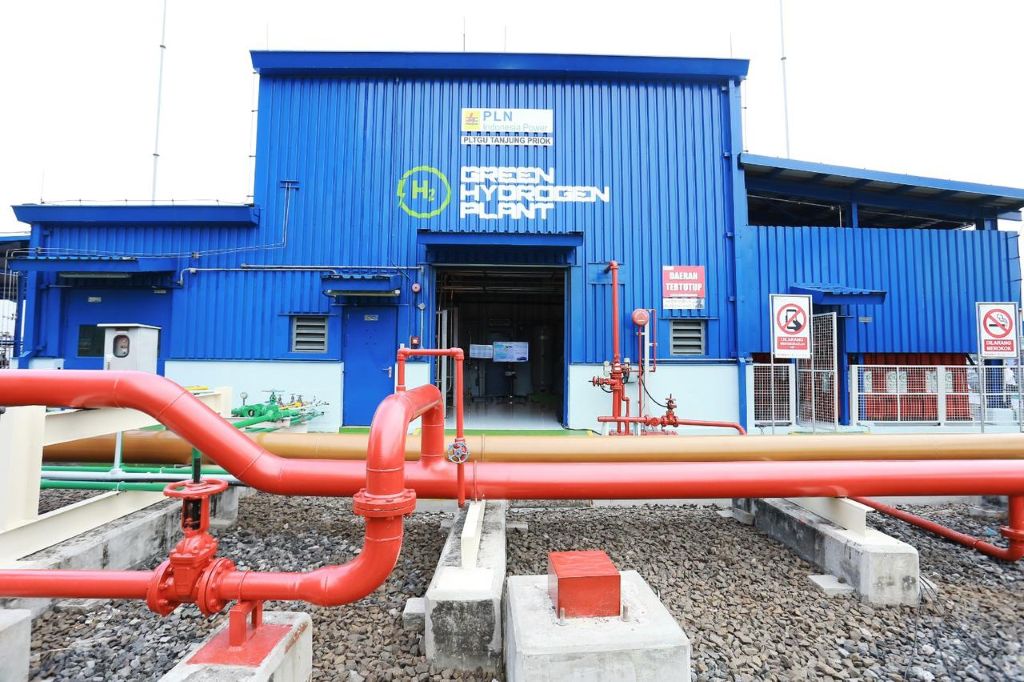
PLN Indonesia Power has once again conducted hydrogen cofiring tests at the Diesel Gas Power Plant in Bali Pesanggaran, continuing the trials carried out last year.
The pre-operation tests, held from November 18–20, 2025, aim to ensure readiness for hydrogen implementation before a wider rollout at power generation facilities.
The event was also attended by Agus Pramono, a member of the National Energy Council, who observed the testing process firsthand.
PLN IP President Director, Bernadus Sudarmanta, expressed his appreciation for the successful series of tests and the collaboration of all parties involved.
According to him, implementing hydrogen cofiring is not merely a technical achievement but also a strategic step in expanding clean energy technology portfolios and strengthening PLN IP’s position as a pioneer in renewable energy innovation.
More Comprehensive Approach
The successful hydrogen cofiring tests in Bali confirm Indonesia Power’s readiness to enter a more advanced energy transition phase.
Hydrogen is no longer just a concept; we have tested and proven that it can be applied safely and effectively at generation assets.
“This is a crucial foundation for our efforts to reduce emissions, improve efficiency, and strengthen the company’s clean energy portfolio. We thank all partners who have contributed, and Indonesia Power will continue innovating to support the Net Zero Emission 2060 target,” Bernadus said in an official statement.
VP of Technology Development and program lead, Hedwig Lunga Sampe Pajung, explained that this year’s testing was conducted with a more comprehensive approach compared to 2024. In the previous trial, tests were only carried out at full load (100%) with a 7% cofiring ratio.
This year, tests involved three different load levels 75%, 85%, and 100% of engine capacity to study engine performance under varied operating conditions.
“This testing was conducted at 75%, 85%, and 100% engine capacity. The hydrogen cofiring ratios reached 23% at 75% load, 22% at 85%, and 17% at 100%. With these variations, we can observe engine behavior under different operating conditions and determine the maximum safe hydrogen limit for each load level,” Hedwig explained.
He added that technical development also focused on the hydrogen supply system using a Pressure Regulator System (PRS) based on Programmable Logic Controller (PLC) and Human Machine Interface (HMI).
This system allows for more precise, stable, and safe hydrogen injection control.
“With full electronic control, the hydrogen feeding process becomes much more stable and precise,” he added. The technical team also noted indications of improved combustion efficiency.
At the same load, total energy consumption combining natural gas and hydrogen was lower compared to pure natural gas combustion.
This is believed to be because hydrogen assists in the continued combustion of carbon monoxide (CO), as reflected by lower CO emissions during cofiring.
Hedwig emphasized that this successful trial is an integral part of PLN IP’s support for the national energy transition roadmap towards Net Zero Emission 2060.
The results demonstrate hydrogen’s potential to be sustainably used as a clean energy source in the future.
“If the economics are also feasible, hydrogen can be supplied continuously as part of the generation decarbonization strategy,” he said.
The success of these trials affirms PLN IP’s readiness as a pioneer in utilizing hydrogen in the power sector while demonstrating the company’s commitment to supporting the national energy transition toward a cleaner and more sustainable future.
Sources : Metrotv, Detikfinance
Feat Image : via PLN IP