
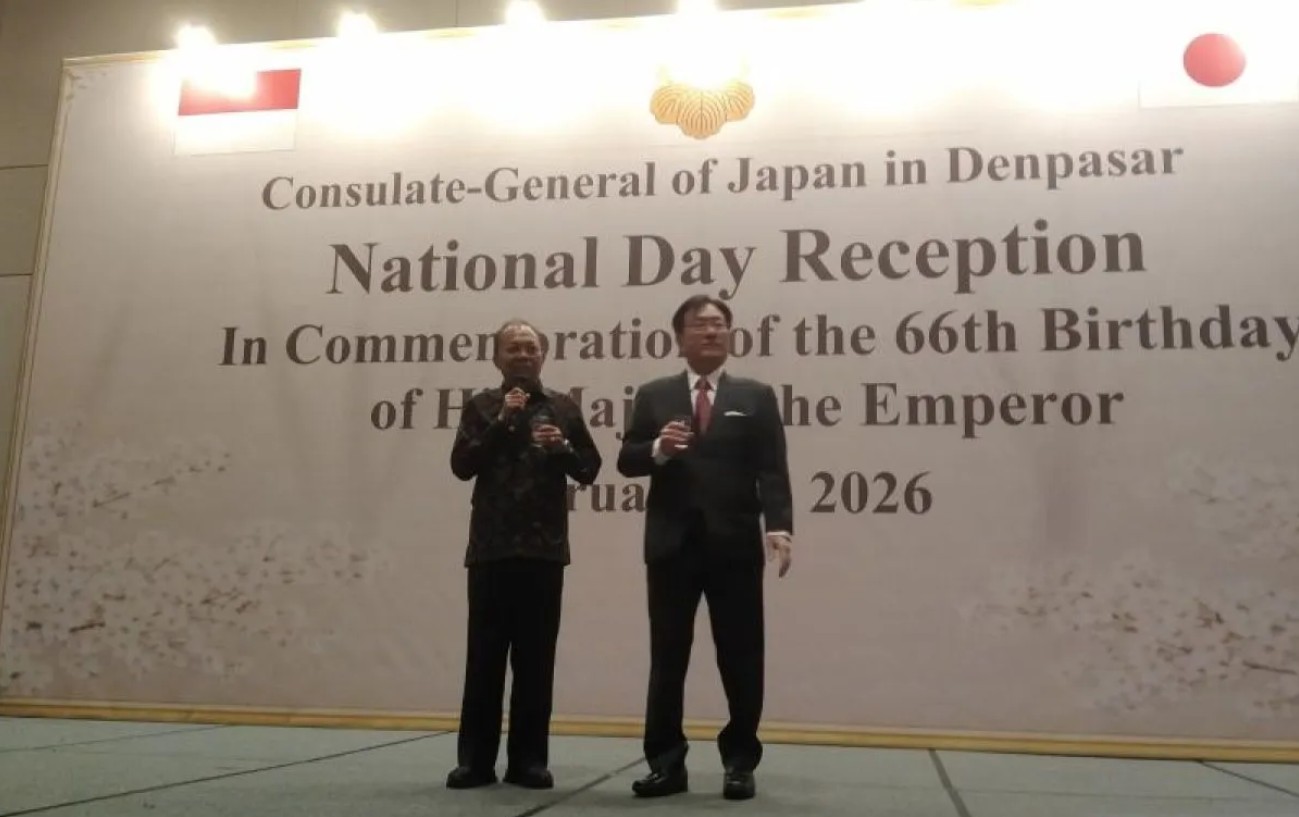
The Government of Japan is moving forward with the second phase of its coastal conservation project in Bali, allocating 9.85 billion yen, or approximately USD 64.17 million, for the initiative.
The program, which began in 2021 and is targeted for completion by 2028, is designed to mitigate coastal erosion along the shores of the Island of the Gods, one of Indonesia’s most prominent tourism destinations.
The project is financed through Japan’s official development assistance scheme and is being implemented by the Directorate General of Water Resources under Indonesia’s Ministry of Public Works.
The second phase represents a continuation and expansion of earlier efforts to protect Bali’s vulnerable coastlines from abrasion while also restoring damaged marine ecosystems, particularly coral reefs.
Japanese Consul General Miyakawa Katsutoshi emphasized Japan’s long-term commitment to Indonesia’s development. Speaking in Denpasar, he stated, “Japan is committed to continuing to contribute to supporting the development of Indonesia that we love.”
He further underscored the broader spirit of collaboration behind the initiative, saying, “Economic cooperation between Japan and Indonesia is not merely an exchange of funds or financial assistance, but more than that, this cooperation is a sincere collaboration to protect people’s lives.”
Broaden Geographical Scope
Phase II of the project is divided into three main work packages covering several strategic coastal areas. Package II focuses on the Kuta–Legian–Seminyak stretch in Badung Regency, an area known for its tourism activity and heavy exposure to wave action and shoreline changes.
Package III includes Nusa Dua, Tanjung Benoa, and Sanur, located in both Badung Regency and Denpasar City. Meanwhile, Package I extends conservation measures to Candidasa in Karangasem Regency, broadening the geographical scope of the project compared to the first phase.
The funding for Phase II marks an increase compared to Phase I, which ran from 2000 to 2008 with a total budget of 9.5 billion yen, or around Rp1.04 trillion, based on an exchange rate assumption of 1 yen equal to Rp109.9.
The higher allocation reflects both expanded coverage areas and the growing urgency of coastal protection efforts amid environmental pressures and climate-related challenges.
During Phase I, substantial engineering and environmental works were carried out. In Sanur, approximately 300,000 cubic meters of sand were used for beach nourishment, alongside the construction of groins and offshore breakwaters.
In Nusa Dua, 340,000 cubic meters of sand were added, complemented by groins and headlands to stabilize the shoreline. In Kuta, 520,000 cubic meters of sand were replenished, combined with offshore breakwaters and coral transplantation initiatives aimed at restoring reef ecosystems.
Coastal protection measures were also implemented along the shoreline of Tanah Lot Temple through the installation of stone and coral panels.
For Phase II, the approach largely mirrors the earlier phase, including sand nourishment and breakwater construction in Kuta–Legian–Seminyak. In Package III areas, sand will be sourced from the Mertasari stockpile and from naturally accumulated sediment.
In Candidasa, activities include sand replenishment, repairs to existing seawalls and groins, and ongoing maintenance. Overall, the project seeks not only to curb coastal abrasion but also to support ecological restoration and safeguard local communities whose livelihoods depend on Bali’s coastal environment.
Sources : Pantau, AntaraNews
Feat Image : via AntaraNews//Dewa Ketut Sudiarta Wiguna