
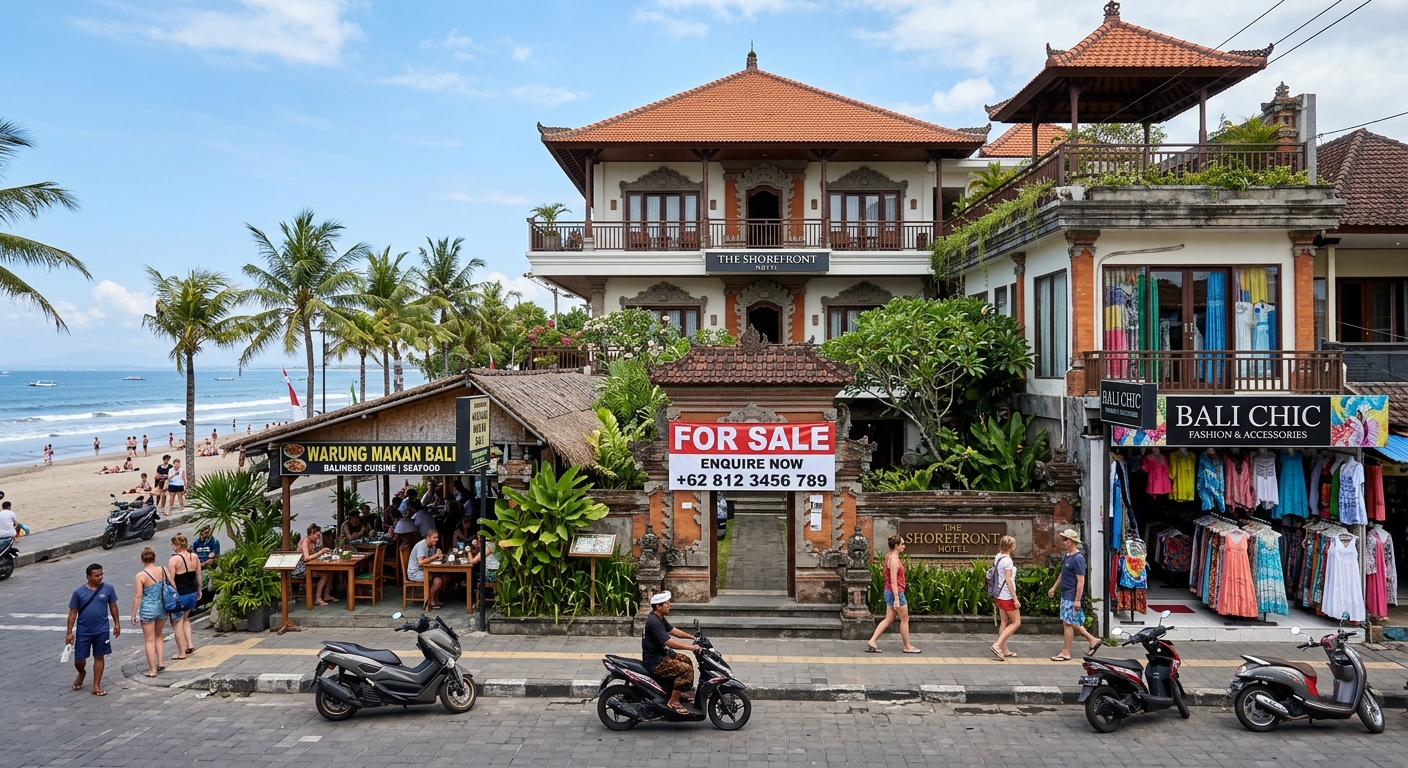
Hotels for Sale Across Bali, Is Tourism Really Under Pressure?

Hotels in Bali


Reports that Bali’s hotel industry is facing pressure, leading to a growing number of properties being put up for sale.

The hotels on offer are spread across several areas, including Badung, Tabanan, Gianyar, and Karangasem. This issue have sparked different views among stakeholders.

One such perspective comes from Eva Monalisa, a member of Indonesia’s House of Representatives. She believes the issue should be viewed within the broader tourism ecosystem, including tourist distribution, infrastructure, transportation, MSMEs (medium-small enterprise, and the creative economy.

“We cannot look at just one aspect, namely hotels. We have to look at the entire tourism chain, including infrastructure, MSMEs, and the creative activities in an area that become attractions for visitors,” Eva told reporters on Monday, September 21, 2026.

Eva emphasized that tourism conditions across Bali are far from uniform. Some areas enjoy high visitor numbers and a large hotel capacity, while others continue to attract relatively fewer tourists.

According to her, the government needs to assess whether low tourist arrivals are linked to infrastructure issues, accessibility to destinations, the attractiveness of individual regions, or even factors such as airfares.


Hotels Must Adapt and Innovate

A more specific view came from the Ministry of Tourism, which urged the public to see the growing number of hotel properties being offered for sale in Bali as part of normal market dynamics.

The ministry said that an increase in hotel property listings should not automatically be interpreted as a sign of decline in Bali’s tourism industry. In many cases, it may simply reflect business decisions made by property owners.

Deputy Tourism Minister Ni Luh Puspa said changes in ownership or decisions to sell hotel properties should be viewed separately from the overall condition of Bali’s tourism sector.

“What we’re seeing today is a tourism market that is becoming increasingly dynamic. Travelers now have a much wider range of accommodation choices, from star-rated hotels and resorts to villas and various other lodging options,” she said.

The Ministry of Tourism also encouraged Bali’s hospitality industry to continue adapting and innovating, particularly in response to growing competition and changing traveler preferences.

“This is why adaptation is so important. Like any other industry, hotels need to keep innovating, while continuously improving the quality of their products and services,” Ni Luh Puspa added.

According to her, businesses can also target a broader range of market segments, including both international and domestic travelers, across leisure tourism, wellness tourism, MICE (Meetings, Incentives, Conferences, and Exhibitions), and experience-based travel.

A similar view was expressed by Tjokorda Oka Artha Ardhana Sukawati, Chairman of the Bali chapter of the Indonesian Hotel and Restaurant Association.

Better known as Cok Ace, he believes that the growing number of hotels and villas being offered for sale in Bali does not automatically indicate that the hospitality industry is under extraordinary pressure.

“The buying and selling of hotels is actually a normal occurrence. What has caught our attention recently is the increase in the number of properties being put up for sale,” Cok Ace said on Tuesday (September 22, 2026).

Echoing Eva’s view, Cok Ace stressed that market conditions are not the same across all parts of Bali. Areas with high occupancy rates continue to have strong investment appeal.

What deserves closer attention, he said, is the weakening domestic market, which has long been one of the key pillars supporting Bali’s tourism industry.

According to Cok Ace, the main challenge facing Bali’s hospitality sector is not declining tourism demand, but the rapid growth in accommodation supply, which has led to increasingly intense competition.

This is particularly evident in South Bali, where tourism activities and accommodation development are most heavily concentrated.

“The gap between supply and demand has simply become too wide. For South Bali, a moratorium is indeed necessary,” he said.


Sources: NusaBali, RMOL

LATEST

Andrzej Barski

Director of Seven Stones Indonesia

Andrzej is Co-owner/ Founder and Director of Seven Stones Indonesia. He was born in the UK to Polish parents and has been living in Indonesia for more than 33-years. He is a skilled writer, trainer and marketer with a deep understanding of Indonesia and its many cultures after spending many years travelling across the archipelago from North Sumatra to Irian Jaya.

His experience covers Marketing, Branding, Advertising, Publishing, Real Estate and Training for 5-Star Hotels and Resorts in Bali and Jakarta, which has given him a passion for the customer experience. He’s a published author and a regular contributor to local and regional publications. His interests include conservation, eco-conscious initiatives, spirituality and motorcycles. Andrzej speaks English and Indonesian.

Terje H. Nilsen

Director of Seven Stones Indonesia

Terje is from Norway and has been living in Indonesia for over 20-years. He first came to Indonesia as a child and after earning his degree in Business Administration from the University of Agder in Norway, he moved to Indonesia in 1993, where he has worked in leading positions in education and the fitness/ wellness industries all over Indonesia including Jakarta, Banjarmasin, Medan and Bali.

He was Co-owner and CEO of the Paradise Property Group for 10-years and led the company to great success. He is now Co-owner/ Founder and Director of Seven Stones Indonesia offering market entry services for foreign investors, legal advice, sourcing of investments and in particular real estate investments. He has a soft spot for eco-friendly and socially sustainable projects and investments, while his personal business strengths are in property law, tourism trends, macroeconomics, Indonesian government and regulations. His personal interests are in sport, adventure, history and spiritual experiences.

Terje’s leadership, drive and knowledge are recognised across many industries and his unrivalled network of high level contacts in government and business spans the globe. He believes you do good and do well but always in that order. Terje speaks English, Indonesian and Norwegian.

Contact Our Consultants

[wpforms id=”43785″]

Ridwan Jasin Zachrie

CFO of Seven Stones Indonesia, Jakarta

Ridwan is one of Indonesia’s top executives with a long and illustrious career in the financial world. He holds several professional certifications including being a Certified Business Valuer (CBV) issued by the Australian Academy of Finance and Management; Broker-Dealer Representative (WPPE); and The Directorship Certification for Directors and Commissioners, issued by the Indonesian Institute of Commissioners and Directors.

His experience includes being the Managing Director at one of the top investment banking groups in the region, the Recapital Group, the CFO at State-owned enterprises in fishery industry and the CEO at Tanri Abeng & Son Holding. He’s also been an Independent Commissioner in several Financial Service companies and on the Audit and Risk Committee at Bank BTPN Tbk, Berau Coal Energy Tbk, Aetra Air Jakarta as well as working for Citibank, Bank Mandiri and HSBC. His last position was as CFO at PT Citra Putra Mandiri – OSO Group.

Ridwan has won a number of prestigious awards including the Best CFO Awards 2019 (Institute of Certified Management Accountant Australia-Indonesia); Asia Pacific Young Business Leader awarded by Asia 21 Network New York USA (Tokyo 2008); UK Alumni Business Awards 2008 awarded by the British Council; and The Most Inspiring Human Resources Practitioners’ version of Human Capital Magazine 2010.

He’s a member of the Board of Trustees of the Alumni Association of the Faculty of Law, Trisakti University, Co-Founder of the Paramadina Public Policy Institute and actively writes books, publications and articles in the mass media. He co-authored “Korupsi Mengorupsi Indonesia” in 2009, which helps those with an interest in understanding governance in Indonesia and the critical issue of corruption. Ridwan speaks Indonesian and English.

Per Fredrik Ecker

Managing Director of Seven Stones Indonesia, Jakarta

Per is the Managing Director of the Seven Stones Indonesia (SSI) Jakarta office and has more than 25-years’ experience in Indonesia, China, and Western Europe. He previously worked in senior management positions with Q-Free ASA, Siemens AG, and other companies in the telecom sector. Over the last six years, he has been the Chairman of the Indonesia-Norway Business Council (INBC) and recently become elected to be on the board of EuroCham Indonesia.

His most recent experience is within Intelligent Transport Solutions (ITS), Telecom, and other sectors within the Indonesian market. He is today through his position in SSI and by representing Norway Connect, promoting Nordic and European companies that would like to explore business opportunities in the Indonesian market. He’s also playing an active role to help create the Nordic House concept in Jakarta that will provide an excellent platform for Nordic companies entering Indonesia, where they’ll find a community that can offer support with trusted information and affordable services to enter this market.