
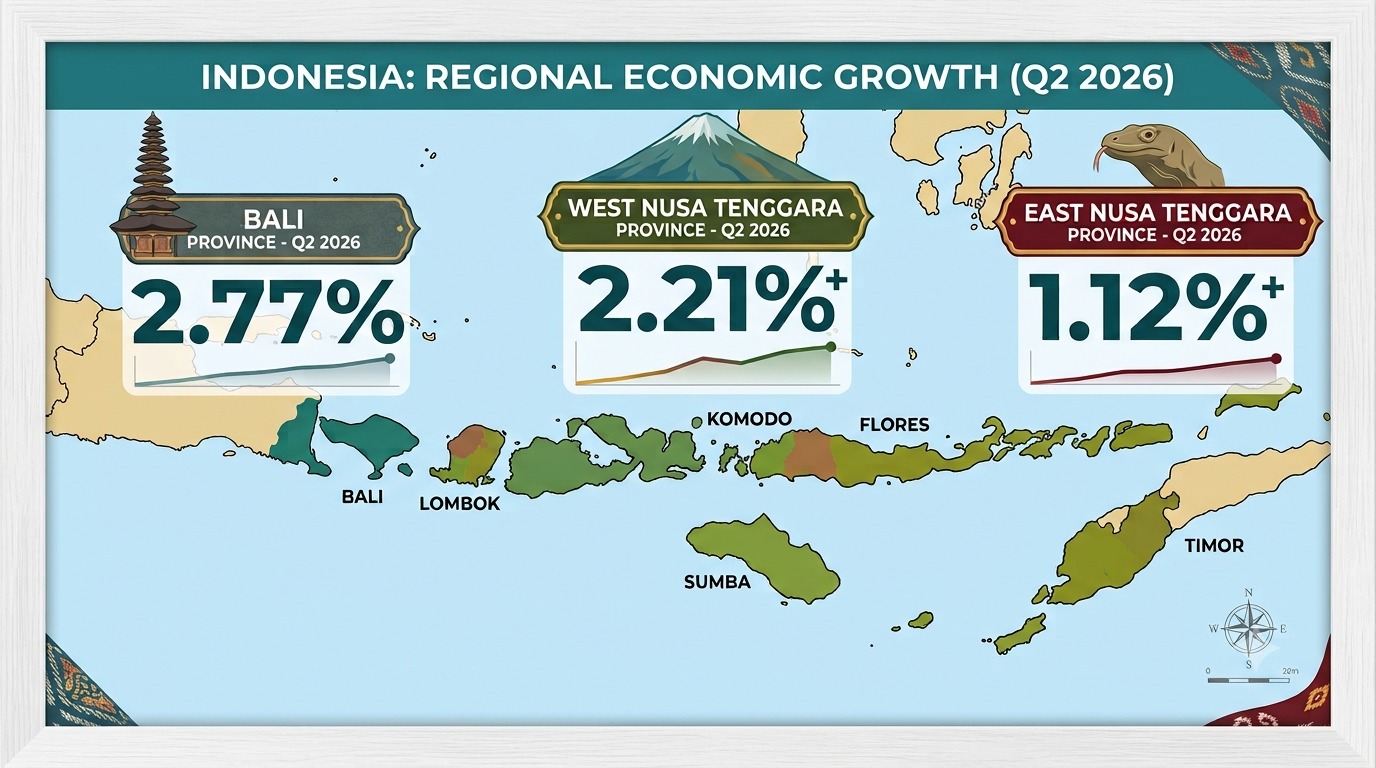
For the second quarter of 2026, Statistics Indonesia recorded an economic growth rate of 6.10% year-on-year for the Bali and Nusa Tenggara region—making it the highest regional growth rate across the entire country.
“The Bali and Nusa Tenggara region grew by 6.10%, which represents the highest growth rate nationwide,” stated M. Edy Mahmud, Deputy for Balance Sheets and Statistical Analysis, at the Statistics Indonesia Office in Central Jakarta on Wednesday (June 5).
Breaking down the figures, the primary driver of this growth came from Bali at 2.77%, followed by West Nusa Tenggara at 2.21% and East Nusa Tenggara at 1.12%.
Meanwhile, Java secured second place with an economic growth of 5.56% over the same period, trailed by Sulawesi at 5.53%, Sumatra at 5.06%, Kalimantan at 4.10%, and Maluku and Papua at 1.36%.
Even so, Edy explained that in terms of overall contribution to the national GDP, Java and Sumatra still hold the top ranks.
“Java’s contribution to GDP remains the highest at 56.47%, followed by Sumatra at 22.50%,” Edy noted.
Inside Bali’s Domestic Economy
Looking specifically at Bali’s localized economy, the provincial office of Statistics Indonesia reported that growth reached 6.91% in the second quarter of 2026. On an annual basis, Bali’s economy expanded by 5.78%.
According to the Head of Statistics Indonesia for Bali province, Agus Gede Hendrayana Hermawan, this figure marks an acceleration compared to the first quarter of 2026.
“Yes, our economy grew quite well this second quarter, moving at a faster pace than what we saw in the previous first quarter,” Agus stated on Wednesday (August 5, 2026).*
Agus explained that Bali’s economic growth was supported by nearly all business sectors. However, transportation and warehousing stood out as the sole sector to experience a contraction on an annual basis.
The accommodation and food service sector remains the backbone of Bali’s economic structure, contributing 21.91%. Despite being the largest contributor, its growth was relatively modest at 3.68% year-on-year.
Meanwhile, agriculture, forestry, and fisheries claimed the second spot with a 12.85% contribution, expanding by 6.35% annually.
Conversely, the transportation and warehousing sector—which accounts for a 10.21% share—contracted by 0.64% year-on-year.